
What Is the Evil Eye? Meaning, History & How to Protect Yourself
The Evil Eye is one of the oldest and most widespread beliefs in the world. Long before the internet, long before modern superstitions, and even before many of today’s religions had taken shape, people believed that envy itself could carry power.
Across continents and centuries, cultures that never met each other told remarkably similar stories. They believed that a jealous glance, excessive admiration, or lingering resentment could bring misfortune to another person. Crops failed, animals became sick, children fell ill, good fortune suddenly disappeared, and many believed the cause could be traced back to something as simple as another person’s gaze.
Whether you see the Evil Eye as a spiritual belief, a piece of cultural folklore, or simply a fascinating tradition that’s survived for thousands of years, its story is woven deeply into human history. Even today, millions of people wear protective charms, recite family prayers, or follow rituals passed down through generations, hoping to keep themselves, their loved ones, and their homes safe from unwanted energy.
So where did this belief come from, and why has it endured for so long?
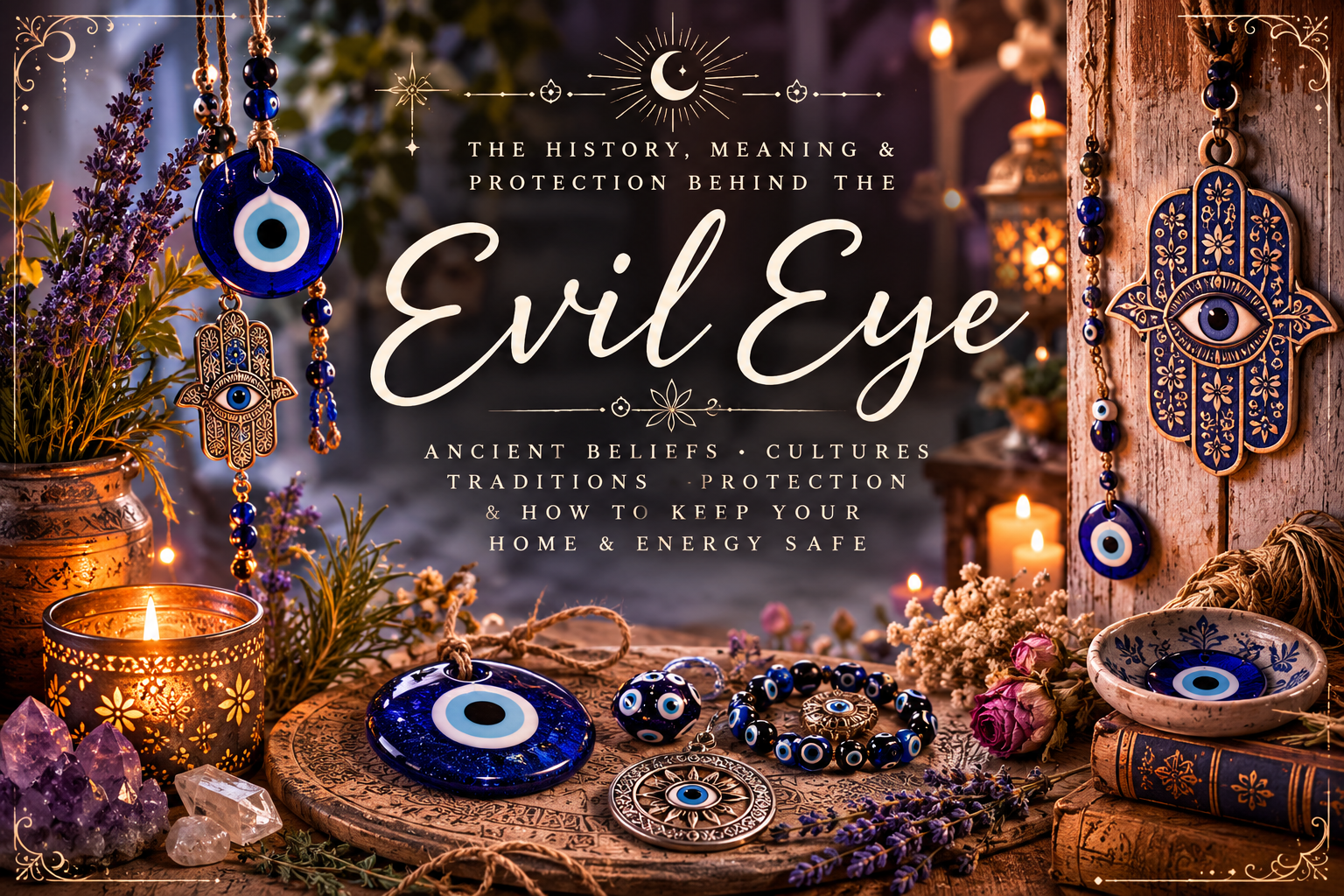
What Is the Evil Eye?
At its heart, the Evil Eye is the belief that envy or jealousy can cause harm.
In many traditions, this harm isn’t always believed to be intentional. A person doesn’t necessarily have to wish you ill or cast a spell against you. Simply longing for what someone else has, admiring them with envy, or dwelling on feelings of resentment was thought to be enough to disturb their good fortune.
According to folklore, the effects could appear in many different ways. A streak of bad luck, constant exhaustion, arguments that seem to come from nowhere, illnesses without an obvious explanation, or plans repeatedly falling apart were all sometimes attributed to the Evil Eye.
Of course, these beliefs come from centuries of tradition rather than scientific evidence. Today, many people view the Evil Eye as part of cultural heritage or spiritual practice rather than something that can be proven. For others, wearing an Evil Eye charm or following protective rituals is less about fear and more about carrying a symbol of protection, hope, and positive intention.
Whatever your perspective, it’s difficult to ignore just how many cultures have preserved this belief across thousands of years.
A Story That Began Thousands of Years Ago
The origins of the Evil Eye stretch back more than 5,000 years, making it one of the oldest surviving beliefs in recorded history.
Some of the earliest references come from ancient Mesopotamia, where carved amulets and written texts suggest people feared the destructive power of envy. Wealth, beauty, health, and success were seen as precious gifts, but they were also believed to attract unwanted attention. Protective symbols were created to guard families, homes, and livestock from misfortune believed to be caused by jealous eyes.
The belief spread throughout the ancient world, finding a home in Egypt, Greece, Rome, the Middle East, and eventually much of Europe. Although every culture told the story a little differently, one idea remained remarkably consistent: envy was never seen as a harmless emotion. Left unchecked, it was thought to have the power to disrupt happiness, prosperity, and peace.
Perhaps that’s why the Evil Eye has survived for so many centuries. Almost everyone has experienced jealousy at some point, whether they’ve felt it themselves or sensed it from others. The belief gave people a way to explain unexpected hardship while also encouraging values like humility, gratitude, and kindness toward others.
Those lessons still resonate today, even for people who see the Evil Eye purely as folklore.
The Evil Eye Across Different Cultures
One of the reasons I find the Evil Eye so fascinating is that it doesn’t belong to just one religion or one country.
Long before the world was connected through travel or the internet, people living thousands of miles apart shared remarkably similar beliefs. They all recognised something deeply human: envy has the power to change how people behave, damage relationships, and leave lasting emotional scars. Over time, many cultures came to believe that those feelings could also carry spiritual consequences.
Although each tradition tells the story a little differently, they all revolve around the same idea. Protect yourself from jealousy, celebrate your blessings with humility, and remember that not every glance carries good intentions.
Ancient Mesopotamia: Where the Story Began
The earliest known references to the Evil Eye date back more than five thousand years to ancient Mesopotamia, often called the cradle of civilisation.
Clay tablets and archaeological discoveries suggest that people believed misfortune could be caused by envious or hostile looks. To protect themselves, they carved symbols into stone, created small protective amulets, and recited prayers asking the gods for protection over their families, homes, crops, and animals.
Life was unpredictable, and when illness struck or a harvest failed without explanation, many believed unseen spiritual forces were at work. The Evil Eye became one way of understanding those unexpected hardships.
Even today, historians consider these early Mesopotamian beliefs to be the foundation from which many later traditions developed.
Ancient Greece: The Curse of Baskania
The ancient Greeks called the Evil Eye baskania, and they believed almost anyone could cast it, often without even realising it.
Excessive admiration, jealousy, or even an overly enthusiastic compliment was sometimes thought to carry harmful energy. Because of this, people often avoided praising someone’s beauty, wealth, or good fortune too enthusiastically without also offering a blessing or words of protection.
In many Greek families, these traditions continue today. Some still recite prayers to remove the Evil Eye, while others wear protective charms or keep them inside their homes. It’s a beautiful example of how ancient folklore can remain part of everyday life, even in the modern world.
Ancient Rome: Protection Through Symbols
The Romans inherited many of their beliefs about the Evil Eye from the Greeks, but they developed their own ways of protecting against it.
One of the most famous protective symbols was the fascinum, an amulet believed to guard against envy and misfortune. Soldiers carried them into battle, children wore them for protection, and families displayed them around their homes in the hope of keeping harmful influences away.
To the Romans, these symbols weren’t simply decorations. They were reminders that good fortune was precious and worth protecting.
Italy and the Tradition of Malocchio
Growing up fascinated by folk magic, I’ve always been especially drawn to the Italian tradition of malocchio, which literally means “the bad eye.”
In many parts of southern Italy, malocchio is still spoken about today, especially among older generations who grew up with stories passed down through their families. Unlike many modern interpretations, malocchio wasn’t always associated with deliberate curses or witchcraft. More often, it was believed to arise from jealousy, resentment, or admiration mixed with envy.
Some families continue to perform traditional rituals using olive oil and water to determine whether someone has been affected by the Evil Eye. Others quietly pass down protective prayers from one generation to the next, often keeping those prayers within the family as treasured traditions rather than something shared publicly.
I love these customs because they remind us that folklore isn’t just found in history books. In many places, it’s still woven into everyday life.
Turkey and the Famous Blue Eye
When most people picture the Evil Eye today, they immediately think of the beautiful blue glass charm found throughout Turkey and many neighbouring countries.
Interestingly, that blue bead isn’t the Evil Eye itself.
It’s called the nazar boncuğu, and it’s designed to protect against the Evil Eye. According to tradition, the watchful eye reflects harmful intentions back to their source before they can reach the person, home, or object it’s protecting.
Over time, the blue eye has become one of the world’s most recognisable symbols of protection. You’ll often see it hanging above doorways, displayed inside homes, attached to keyrings, worn as jewellery, or even placed in cars by people who believe it helps guard both travellers and their journeys.
Whether viewed as a spiritual talisman or a meaningful cultural tradition, it has become a symbol recognised across the globe.
Different Stories, One Shared Message
Although these traditions come from different parts of the world, they all tell a remarkably similar story.
They remind us that envy has always been part of the human experience. Long before psychology gave us words to describe jealousy or insecurity, our ancestors created stories and symbols to make sense of those emotions and protect the things they cherished most.
Perhaps that’s why the Evil Eye has never truly disappeared.
For some people, it’s a deeply held spiritual belief. For others, it’s an important part of their cultural heritage. And for many, it’s simply a beautiful reminder to move through life with gratitude, humility, and kindness while protecting the peace they’ve worked so hard to create.
Can Someone Cast the Evil Eye Without Realising It?
One of the biggest misconceptions about the Evil Eye is that it’s always intentional. According to many traditions, that’s rarely the case.
In fact, countless cultures believe a person can cast the Evil Eye without any desire to cause harm. A passing feeling of jealousy, a moment of envy, or even intense admiration was sometimes thought to be enough. The person wasn’t believed to be evil or practising witchcraft. They were simply experiencing a very human emotion.
Imagine someone admiring your beautiful home, your flourishing garden, a happy relationship, or a new opportunity you’ve been given. Most compliments come from a genuine place of kindness, but folklore teaches that when admiration becomes tangled with envy or longing, it can unintentionally carry negative energy.
This belief is one of the reasons humility is valued so highly in many Mediterranean cultures. Rather than drawing attention to every success or possession, people were encouraged to celebrate quietly, offer gratitude for their blessings, and avoid stirring unnecessary jealousy in others.
Whether you see that as spiritual wisdom or simply good life advice, it’s a tradition that has endured for thousands of years.
Traditional Signs of the Evil Eye
Every culture has its own interpretation of how the Evil Eye might appear, and there isn’t one universal list of signs. These beliefs have been passed down through generations as folklore rather than scientific fact, which is important to remember.
Traditionally, people associated the Evil Eye with periods of unusual misfortune or a string of events that seemed difficult to explain.
Some of the most commonly mentioned signs include:
- A sudden run of bad luck.
- Feeling unusually tired or emotionally drained.
- Frequent headaches without an obvious cause.
- Unexpected arguments with loved ones.
- Plans repeatedly falling apart at the last minute.
- A sense that everything seems to be going wrong all at once.
- Restlessness or difficulty sleeping.
- Feeling emotionally “heavy” for no clear reason.
Of course, these experiences can have many perfectly ordinary explanations, and it’s always important to look after your physical and mental wellbeing first. For many people, the Evil Eye is part of cultural tradition rather than a literal explanation for life’s challenges.
The Traditional Olive Oil Test
One of the most well-known folk traditions associated with malocchio comes from southern Italy, where families have used a simple ritual involving olive oil and water for generations.
The practice varies from region to region, but the basic idea remains much the same. A few drops of olive oil are placed into a bowl or glass of water while a quiet prayer is spoken.
According to tradition, the way the oil behaves offers insight into whether the person may have been affected by the Evil Eye. If the oil remains together and floats naturally, some believe no malocchio is present. If the drops spread apart, break into many smaller droplets, or create unusual patterns, it’s traditionally interpreted as a sign that cleansing may be needed.
From a scientific perspective, olive oil naturally reacts differently depending on factors such as temperature, surface tension, and the container being used. For those who practise this family tradition, however, the ritual is less about proving anything and more about preserving a piece of cultural heritage that has been lovingly passed from one generation to the next.
Family Prayers and Folk Traditions
In many Italian families, removing the Evil Eye wasn’t considered something anyone could do.
The prayers were traditionally passed from one family member to another, often from an older woman to a younger relative, and many believed they could only be taught on special occasions such as Christmas Eve or Christmas Day. Some families still keep these prayers private, seeing them as sacred traditions that should remain within the family rather than being shared publicly.
What I find especially beautiful about these customs is the sense of continuity they create. Whether someone believes the prayers hold spiritual power or simply treasures them as family traditions, they represent generations of shared history, love, and care.
They remind us that folklore isn’t only about old stories. It’s also about the traditions that quietly connect us to the people who came before us.
A Tradition That Continues Today
Although the Evil Eye has ancient origins, it hasn’t been left behind in history.
Walk through markets in Greece or Turkey, browse small artisan shops in Italy, or visit homes throughout the Mediterranean, and you’ll still find protective charms hanging by front doors, displayed inside homes, or worn as jewellery. These traditions have adapted to modern life while holding onto the same comforting symbolism they’ve carried for centuries.
For some, those charms represent spiritual protection. For others, they’re a meaningful reminder to protect their peace, appreciate what they have, and move through life with kindness rather than envy.
Whatever you believe, there’s something rather lovely about a tradition that has brought comfort to people for more than five thousand years.
Where to Place an Evil Eye Charm
One of the lovely things about the Evil Eye charm is that there isn’t one “correct” place to keep it. Different cultures have developed their own traditions over centuries, and many people choose a location based on what feels meaningful to them.
Perhaps the most well-known place is above or beside the front door.
The entrance to a home has long been seen as more than just a doorway. In many folk traditions, it’s considered the threshold between the outside world and your personal sanctuary. Hanging an Evil Eye charm near the entrance is believed to welcome positive energy while discouraging envy or negativity from crossing into the home.
I keep one beside my front door, where it’s one of the first things visitors see when they arrive. Whether you view it as spiritual protection or simply a meaningful tradition, I love the quiet reminder that home should always be a place of comfort, kindness, and peace.
Other Traditional Places to Keep an Evil Eye
Across different cultures, you’ll find Evil Eye charms almost everywhere.
Many people wear them as necklaces, bracelets, earrings, or rings, believing the symbol offers protection throughout the day while also serving as a reminder to carry themselves with gratitude and humility.
Others hang them inside their homes, placing them in living rooms, kitchens, or near windows where they can catch the light. Some families believe this helps create a peaceful atmosphere while symbolically protecting the household.
It’s also common to see them hanging inside cars. For many, this tradition represents a wish for safe journeys and protection while travelling.
Some parents choose to place a small Evil Eye charm in a baby’s nursery or on a pram. This practice comes from old cultural traditions and is intended as a loving symbol of protection rather than something to fear.
I’ve even seen them hanging in gardens, greenhouses, or attached to potted plants. Whether they’re there because of family tradition or simply because someone enjoys the symbolism, they add a beautiful reminder that the spaces we care for are worth protecting.
Ultimately, where you place an Evil Eye charm is a personal choice. For many people, it’s less about finding the “perfect” location and more about placing it somewhere that brings a sense of comfort and positive intention.
Other Traditional Ways to Protect Against the Evil Eye
The famous blue eye may be the best-known symbol today, but it isn’t the only tradition that has been passed down over the centuries.
Different cultures developed their own ways of seeking protection, often using everyday objects found around the home.
Some Mediterranean families hang bundles of rosemary or rue near entrances, believing these herbs help cleanse unwanted energy. Salt has long been used in many traditions as a symbol of purification, while others light candles or say quiet prayers to bless their homes and loved ones.
In parts of the Middle East and North Africa, the Hamsa Hand is another well-known protective symbol. Often featuring an eye at its centre, it represents blessings, strength, and protection from envy.
Many of these customs share something in common. They’re simple rituals that encourage people to pause, set an intention, and care for the spaces and relationships that matter most.
Does the Evil Eye Really Exist?
This is probably the question people ask most often, and the answer depends entirely on who you ask.
For some, the Evil Eye is a deeply held spiritual belief supported by generations of family tradition. Others see it as an important part of their cultural heritage, even if they don’t believe it has literal power. And for many people, it’s simply a fascinating piece of folklore that offers a glimpse into how our ancestors understood the world around them.
What makes the Evil Eye so remarkable isn’t whether everyone believes in it. It’s the fact that versions of this tradition have survived for more than five thousand years, crossing languages, religions, and continents while remaining recognisable to millions of people today.
Whether you wear a blue charm around your neck, keep one by your front door, or simply enjoy learning about old folklore, the Evil Eye continues to remind us of something timeless: our thoughts, our intentions, and the way we treat one another have always mattered.
Final Thoughts
The Evil Eye is much more than a striking blue charm hanging in a shop window.
It’s a story that has travelled through ancient civilisations, crossed oceans, and been lovingly passed from one generation to the next. Along the way, it has become woven into family traditions, protective rituals, and everyday life for millions of people around the world.
Whether you approach it as folklore, spirituality, or cultural history, I think its lasting appeal comes from something deeply human. We all want to protect the people we love, create homes that feel safe and welcoming, and hold on to the good things in our lives. The symbols may differ from one culture to another, but that desire remains the same.
If nothing else, I hope this article has shown that the Evil Eye is far richer than the myths often shared online. Behind the blue glass charm is a history spanning thousands of years, filled with stories of resilience, tradition, and the quiet hope that kindness and gratitude will always be stronger than envy.