Sacred Celtic Trees & Their Meanings in Druid Magic
There has always been something magical about trees. Maybe it’s because they’ve stood in the same place for decades, sometimes even centuries, quietly watching the world change around them. They survive storms, harsh winters, and seasons of stillness, yet every spring they begin again without complaint.
I think there’s something comforting about that. Whenever I walk through a forest, I just slow down and the world feels quieter beneath the canopy of old trees; the air smells different, and for a little while, everything outside those woods seems less important.
Nature has always felt like one of my greatest teachers.
Long before books, social media, and endless Google searches, people learned by watching the natural world around them. They noticed when certain trees flowered, when leaves changed colour, which plants healed wounds, and which forests carried an almost sacred silence.
Among those people were the Druids. To them, trees weren’t simply part of the landscape. They were living symbols of wisdom, protection, transformation, and the connection between the physical and spiritual worlds. Every species carried its own meaning, and many became deeply woven into Celtic folklore and magical traditions.
Whether every story has survived exactly as it was originally told, we’ll probably never know. That’s part of what makes Druid traditions so fascinating. Many teachings were passed down orally from one generation to the next, meaning some knowledge has been preserved, some has evolved, and some has simply been lost to time.
Today, modern witches, pagans, and nature lovers continue to honour many of these sacred trees, not because we can prove every legend beyond doubt, but because the symbolism still speaks to us. Personally, I love that.
Magic doesn’t always have to come from certainty; sometimes it comes from connection.
Whether you practise witchcraft yourself or you’re simply curious about the folklore surrounding these beautiful trees, I hope this guide inspires you to look at forests a little differently the next time you go for a walk. You might be surprised by what you notice.
What Is Celtic Tree Magic?
At its heart, Celtic Tree Magic is the practice of building a spiritual relationship with trees and recognising the symbolic meanings they have carried throughout Celtic traditions for centuries. Each tree represents different qualities, energies, and life lessons.
– The mighty oak symbolises strength and endurance.
– The graceful willow reminds us of intuition and emotional healing.
– The ancient yew teaches us about endings, transformation, and new beginnings.
Rather than viewing trees as ordinary plants, Celtic traditions often saw them as living companions that connected the human world with something much older and far wiser.
Many modern witches continue working with tree correspondences today through meditation, seasonal rituals, spellwork, journaling, and simply spending quiet time in nature.
One of the things I love most about tree magic is how accessible it is. You don’t need an elaborate altar, expensive crystals, or shelves full of magical tools. Sometimes all you need is a peaceful walk through the woods and the willingness to slow down long enough to notice what’s already there.
Why Were Trees So Sacred?
Trees give us far more than shade. They provide shelter for wildlife, clean the air we breathe, nourish the soil beneath our feet, and quietly stand as witnesses to generations of human history.
Ancient cultures understood this deeply. The Celts believed many trees carried unique spiritual qualities and acted as bridges between different worlds. Their roots stretched deep into the earth while their branches reached toward the heavens, making them powerful symbols of balance and connection.
It’s no wonder they became central figures in myths, rituals, and ceremonies. Even today, it’s difficult to stand beneath an enormous oak or an ancient yew without feeling something. Whether you call it energy, presence, peace, or simply appreciation for nature, trees have a remarkable way of reminding us that we’re part of something much bigger than ourselves.
A Brief History of the Druids
The Druids were respected members of ancient Celtic societies, serving as spiritual leaders, teachers, judges, philosophers, healers, and keepers of tradition. Unlike many ancient cultures, the Druids rarely recorded their knowledge in writing. Instead, their teachings were passed from teacher to student through spoken stories, poetry, songs, and years of careful learning.
Some historians believe a Druid’s education could take nearly twenty years to complete. Imagine trying to finish university without taking a single note. As frustrating as that sounds for historians, it’s one of the reasons Druid traditions remain so mysterious today.
Much of what we know comes from archaeological discoveries, Roman writers, later medieval manuscripts, and surviving Celtic folklore. Some of these sources are incredibly valuable, while others should be read with a little caution, especially since Roman accounts were often written by people who viewed the Celts as outsiders.
Because of this, separating historical fact from later legend isn’t always easy. Personally, I think that’s okay. The mystery is part of the charm.
What remains consistent across both history and folklore is the deep respect the Druids held for the natural world, especially forests and sacred groves. Rather than building enormous temples from stone, many ceremonies were believed to take place beneath open skies, surrounded by ancient trees.
Nature wasn’t simply where they practised. It was part of the practice itself.
The Celtic Tree Calendar
If you’ve spent any time exploring Celtic spirituality, you’ve probably come across something called the Celtic Tree Calendar.
It’s a fascinating system that links different periods of the year with specific trees, each representing its own qualities, lessons, and symbolic energy. Many modern witches enjoy using it as a way to deepen their connection with nature and to reflect on the changing seasons.
The Tree Calendar is often connected with the Ogham alphabet, an early Irish writing system made up of simple lines carved along a central stem. Many of its symbols are associated with trees and plants, which is why the two are so often linked in modern witchcraft.
That said, historians still debate whether there was ever a historical “Tree Calendar” used by the ancient Druids in exactly the way it’s presented today. Much of the modern version was developed from later interpretations of Celtic traditions rather than direct historical evidence.
Does that make it any less meaningful? I don’t think so. History and spirituality aren’t always the same thing. Sometimes a practice survives because it helps people feel more connected to the natural world, even if its exact origins are difficult to prove.
For me, the Tree Calendar is less about following strict dates and more about noticing the rhythms of nature. Watching the seasons change, paying attention to the trees around me, and remembering that growth, rest, change, and renewal all have their own time.
Nature has been keeping the best calendar long before humans ever invented one.
How to Work With Tree Magic
One of my favourite things about tree magic is that it doesn’t ask you to buy anything. All you need is a walk in the woods.
Tree magic is about slowing down enough to build a relationship with the living world around you. It begins with observation, curiosity, and respect.
Here are some of my favourite ways to connect with tree energy.
🌳 Spend Time With a Tree
It sounds almost too simple. Find a tree that draws your attention and spend a few quiet minutes sitting nearby.
– Notice its bark.
– Its leaves.
– The sounds around it.
– The way the light moves through the branches.
Sometimes simply being present is enough.
🌳 Collect Only What Nature Gives
One of the most important lessons I’ve learned is not to take more than I need.
Instead of breaking branches or picking leaves from healthy trees, I prefer collecting what nature has already offered: fallen leaves, acorns, seed pods, bark lying on the ground, or small fallen twigs.
It feels more respectful somehow.
🌳 Meditate Beneath a Tree
– Close your eyes.
– Take a few slow breaths.
– Imagine your own energy settling like roots into the earth while your thoughts grow upward like branches reaching for the sky.
It’s one of the simplest grounding exercises I know, and one I come back to often.
🌳 Keep a Nature Journal
– Write down which trees you notice throughout the year.
– Sketch their leaves.
– Press a fallen leaf between the pages.
– Record how different forests make you feel.
Over time, you’ll begin recognising your own personal connections with certain trees, and those relationships often become far more meaningful than memorising lists of correspondences.
🌳 Create Respectfully
Whether you’re using leaves in spellwork, fallen branches for wands, or acorns on your altar, remember that these trees were here long before us. Treat them like living neighbours rather than resources to be harvested.
A quiet thank you costs nothing. Sometimes it’s the most meaningful offering of all.
Before We Meet the Trees…
The eleven trees you’re about to discover have been honoured in Celtic traditions for generations, each carrying its own stories, symbolism, and magical associations. Whether you connect deeply with one tree or find yourself drawn to several, remember that there isn’t a right or wrong way to build a relationship with nature.
Sometimes the tree chooses you; sometimes you simply notice it standing quietly beside the path, waiting for you to slow down. Either way, I think that’s where the magic begins.
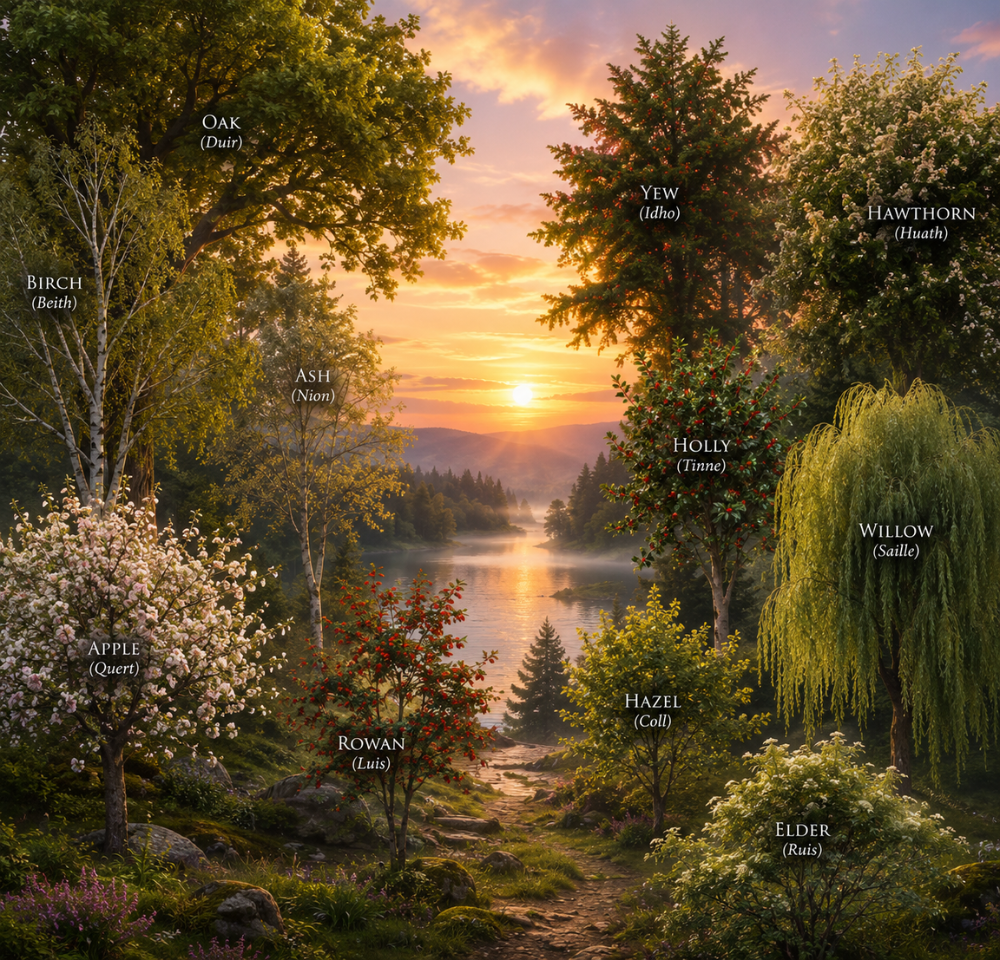
The 11 Sacred Celtic Trees
1. Oak (Duir)
Strength, Protection & Wisdom
If there were ever a king among trees, it would probably be the mighty oak.
The oak was one of the most sacred trees in Celtic tradition and is closely associated with the Druids themselves. In fact, many historians believe the word Druid may be connected to the Celtic word Duir, meaning “oak,” although this remains debated.
Towering above the forest with its enormous branches and deep roots, the oak became a symbol of endurance, leadership, courage, and protection. It could survive fierce storms, lightning strikes, and centuries of changing seasons, making it the perfect representation of resilience.
In many ancient cultures, the oak was also connected with thunder gods because it was often struck by lightning. Rather than seeing this as bad luck, it was viewed as a sign of divine power.
Magical Correspondences
🌳Keywords: Strength, protection, courage, wisdom, grounding, endurance.
🌳Element: Earth
🌳Season: Summer
Best used for:
• Protection spells
• Grounding rituals
• Confidence and courage
• Home blessings
• Stability during difficult times
Ways to Work with Oak
- Carry an acorn in your pocket as a symbol of strength and new beginnings.
- Meditate beneath an oak tree whenever life feels uncertain or overwhelming.
- Collect fallen oak leaves or acorns to place on your altar during protection rituals.
Write down a fear you’d like to overcome and bury it beneath an oak tree as a symbolic act of release. Always do this respectfully and never leave litter behind.
2. Ash (Nion)
Connection, Balance & Growth
In Celtic mythology, the ash tree was often seen as a bridge between worlds. Its tall, straight trunk reaching toward the sky while its roots stretched deep into the earth made it a powerful symbol of balance and connection. Many traditions associated ash with wisdom, spiritual growth, and the journey between the physical and unseen realms.
Ash wood was also highly valued for making tools, walking staffs, and spears because of its remarkable flexibility and strength. It bends without breaking.
I think there’s something beautifully symbolic about that. Sometimes resilience isn’t about standing perfectly still through every storm. Sometimes it’s about learning when to bend instead.
Magical Correspondences
🌳Keywords: Balance, communication, wisdom, spiritual growth, adaptability.
🌳Element: Air
🌳Season: Spring
Best used for:
• Meditation
• Divination
• Dream work
• Spiritual journeys
• Personal growth
Ways to Work with Ash
- Meditate while holding a fallen ash twig during times of change.
- Write down a goal and place it beneath an ash leaf in your journal.
- Carry a small piece of naturally fallen ash wood as a reminder to stay flexible when life doesn’t go according to plan.
3. Yew (Idho)
Death, Transformation & Renewal
The yew has always carried an air of mystery.
Ancient yew trees can live for thousands of years, making them some of the oldest living organisms in Europe. Many churchyards and sacred sites still contain yews that have quietly watched generations come and go. Because of their incredible lifespan, they became symbols of death, rebirth, transformation, and eternal life.
That might sound a little intimidating, but yew magic isn’t about endings for the sake of endings. It’s about making space for something new. Sometimes we have to let go before we can grow.
Magical Correspondences
🌳 Keywords: Transformation, endings, renewal, ancestors, wisdom.
🌳Element: Water
🌳Season: Winter
Best used for:
• Shadow work
• Letting go
• Honouring ancestors
• Personal transformation
• Major life transitions
Ways to Work with Yew
- Journal about something you’re ready to release.
- Create a ritual marking the end of one chapter before beginning another.
- Meditate near an old tree while reflecting on how much you’ve already grown.
4. Birch (Beith)
New Beginnings & Cleansing
If the oak is the wise elder of the forest, the birch feels like spring itself. With its bright white bark and graceful appearance, birch has long symbolised fresh starts, hope, purification, and renewal.
In Celtic tradition, birch was often one of the first trees to grow after woodland fires or cleared land, making it a powerful symbol of resilience and new beginnings. It’s the tree that quietly whispers: “You get to start again.” And honestly? Sometimes we all need to hear that.
Magical Correspondences
🌳Keywords: Renewal, healing, purification, fresh starts, hope.
🌳Element: Air
🌳Season: Spring
Best used for:
• House cleansing
• New home blessings
• Starting new projects
• Personal healing
• Releasing old habits
Ways to Work with Birch
- Sweep your doorway with a small birch broom before beginning a new chapter.
- Decorate your altar with naturally fallen birch bark.
- Light a white candle while reflecting on the new beginning you’d like to invite into your life.
5. Apple (Quert)
Love, Abundance & The Otherworld
Apples have appeared in myths and legends for thousands of years. In Celtic folklore, the apple tree was associated with love, beauty, healing, abundance, and the mystical Otherworld. It represented nourishment not only for the body, but also for the spirit.
The blossoms arrive in spring with incredible beauty, and by autumn the tree generously offers its fruit. There’s something wonderfully balanced about that rhythm. The apple reminds us that growth takes time, and every season has its purpose.
Magical Correspondences
🌳Keywords: Love, fertility, abundance, beauty, healing.
🌳Element: Water
🌳Season: Autumn
Best used for:
• Love spells
• Gratitude rituals
• Kitchen witchcraft
• Prosperity work
• Family blessings
Ways to Work with Apple
- Share apples during harvest celebrations.
- Dry apple slices for seasonal decorations or magical crafts.
- Write down things you’re grateful for while enjoying an apple outdoors.
6. Rowan (Luis)
Protection & Intuition
Few trees have been surrounded by as much protective folklore as the rowan.
Often called the Witch Tree or the Mountain Ash, rowan has been carried, planted, and honoured for centuries as a symbol of protection against misfortune and unwanted energies.
Its bright red berries were believed to ward off negativity, while its graceful branches represented courage and spiritual awareness.
Even today, many witches continue working with rowan for protection, intuition, and strengthening personal boundaries.
Magical Correspondences
🌳Keywords: Protection, intuition, courage, psychic awareness, boundaries.
🌳Element: Fire
🌳Season: Autumn
Best used for:
• Protective charms
• Divination
• Strengthening intuition
• Home protection
• Spiritual boundaries
Ways to Work with Rowan
- Carry a small naturally fallen rowan twig during times when you need extra confidence.
- Meditate beneath a rowan tree before divination or tarot readings.
- Add rowan leaves or berries, if ethically collected and safe to handle, to seasonal altar displays.
7. Hawthorn (Huath)
The Faerie Tree, Love & Transformation
Few trees carry as much mystery as the hawthorn. Often known as the Faerie Tree, hawthorn has long been associated with the unseen world, magic, fertility, and transformation. Throughout Celtic folklore, lone hawthorn trees were believed to mark places where the veil between worlds was especially thin, making them deeply respected and, in some traditions, never disturbed.
Because of these beliefs, many people avoided cutting down mature hawthorn trees, fearing it would bring misfortune or offend the fae. Whether you believe those stories literally or simply appreciate the symbolism, hawthorn encourages us to respect the mysteries of nature rather than trying to control them.
Magical Correspondences
🌳Keywords: Transformation, love, fertility, intuition, faerie magic.
🌳Element: Air
🌳Season: Spring
Best used for:
• Love spells
• Beltane celebrations
• Spiritual growth
• Working with intuition
• Personal transformation
Ways to Work with Hawthorn
- Meditate beneath a hawthorn tree during spring to reflect on personal growth.
- Decorate your altar with naturally fallen blossoms or leaves when they’re available.
- Spend time quietly observing nature without expecting anything in return. Sometimes simply being present is enough.
8. Holly (Tinne)
Courage, Protection & Inner Strength
With its glossy evergreen leaves and bright red berries, holly has long symbolised protection, resilience, and the ability to remain strong during life’s darkest seasons.
Unlike many trees that lose their leaves during winter, holly stays vibrant throughout the colder months. For that reason, it became a symbol of endurance, hope, and quiet determination.
In Celtic traditions, holly was often associated with protection against harmful influences and was believed to guard homes and sacred spaces.
Today, many witches continue using holly during winter rituals and Yule celebrations as a reminder that even in times of darkness, life continues beneath the surface.
Magical Correspondences
🌳Keywords: Protection, courage, resilience, confidence, winter magic.
🌳Element: Fire
🌳Season: Winter
Best used for:
• Protection rituals
• Yule celebrations
• Building confidence
• Home blessings
• Strength during difficult times
Ways to Work with Holly
- Display holly branches during winter celebrations.
- Reflect on the challenges you’ve already overcome while meditating with holly nearby.
- Use holly as a reminder that difficult seasons never last forever.
9. Willow (Saille)
Intuition, Healing & The Moon
If the oak represents strength, the willow represents gentleness. Gracefully bending beside rivers and lakes, willow has long been associated with emotions, dreams, intuition, and the ever-changing cycles of the moon.
Its flexible branches remind us that true strength doesn’t always mean standing rigid. Sometimes it means adapting without losing ourselves. Because willow thrives near water, it naturally became connected with emotional healing, psychic awareness, creativity, and feminine energy.
It’s one of my favourite trees to think about whenever life feels emotionally overwhelming.
Magical Correspondences
🌳Keywords: Intuition, dreams, healing, emotional balance, moon magic.
🌳Element: Water
🌳Season: Spring
Best used for:
• Dream work
• Moon rituals
• Emotional healing
• Divination
• Creativity
Ways to Work with Willow
- Spend time near a willow tree during a Full Moon or New Moon.
- Journal about your emotions while sitting beside flowing water.
- Create artwork, poetry, or music inspired by the peaceful energy willow represents.
10. Hazel (Coll)
Wisdom, Creativity & Inspiration
Hazel has long been associated with wisdom, knowledge, creativity, and inspiration throughout Celtic mythology. One of the best-known legends tells of the Salmon of Wisdom, who gained all the knowledge in the world after eating hazelnuts that had fallen into a sacred well surrounded by hazel trees. Whether taken literally or symbolically, hazel reminds us that wisdom grows through curiosity, observation, and lifelong learning.
As someone who regularly disappears down random research rabbit holes, I have a soft spot for that idea.
Magical Correspondences
🌳Keywords: Wisdom, creativity, learning, inspiration, insight.
🌳Element: Air
🌳Season: Autumn
Best used for:
• Studying
• Creative projects
• Journaling
• Divination
• Problem solving
Ways to Work with Hazel
- Keep hazelnuts or hazel leaves on your desk while studying or writing.
- Meditate before beginning a creative project.
- Spend time reading beneath a tree, allowing nature to become part of your learning process.
11. Elder (Ruis)
Transformation, Protection & Ancestral Wisdom
The elder tree has long been surrounded by folklore, mystery, and deep respect.
Across many parts of Europe, elder was believed to house protective spirits, and people often asked permission before cutting its branches or using its wood. Whether taken as literal belief or symbolic tradition, the practice encouraged respect for the living world rather than taking from it without thought.
Elder is often associated with endings, transformation, healing, ancestral wisdom, and the cycles of life and death. Rather than representing fear, it reminds us that every ending creates space for something new to begin.
It’s a tree that quietly teaches acceptance, patience, and the importance of honouring those who came before us.
Magical Correspondences
🌳Keywords: Transformation, protection, healing, ancestors, wisdom.
🌳Element: Water
🌳Season: Autumn
Best used for:
• Ancestor work
• Shadow work
• Healing rituals
• Protection
• Life transitions
Ways to Work with Elder
- Spend time reflecting on family traditions and the lessons passed down through generations.
- Journal about the changes currently unfolding in your life.
- If you work with ancestor altars, consider decorating them with naturally fallen elder leaves or flowers when available.
How to Practice Tree Magic Respectfully
One of the most beautiful things about tree magic is that it encourages us to build a relationship with nature rather than simply taking from it. If there’s one thing I’d encourage, it’s to approach every tree with gratitude and respect.
Whenever possible, collect only what has already fallen naturally. Leaves, acorns, twigs, bark, and seed pods often make wonderful additions to your practice without causing any harm.
Avoid stripping bark, cutting healthy branches, or taking anything from protected parks or nature reserves.
If you enjoy leaving offerings, choose things that won’t damage the environment. A quiet thank you, a few moments of gratitude, a song, or simply caring for the space around the tree can be just as meaningful as any physical gift.
Above all, remember that nature isn’t something we own. It’s something we’re incredibly fortunate to share.
Frequently Asked Questions
Do I need to be Celtic to practise tree magic?
Not at all. Many people from different spiritual backgrounds work with tree symbolism respectfully. The important part is approaching these traditions with curiosity, appreciation, and respect for their history.
What if these trees don’t grow where I live?
That’s perfectly okay. Learn about the native trees in your own area as well. Building a relationship with the landscape around you can be just as meaningful.
Can I collect leaves, acorns, and branches?
Yes, provided they’ve fallen naturally and you’re allowed to collect them where you are. Always check local rules and avoid disturbing protected areas.
Is the Celtic Tree Calendar historically accurate?
Not entirely. While it’s inspired by Celtic traditions and the Ogham alphabet, historians continue debating whether the ancient Druids used it exactly as it’s presented today. Many modern witches still find it a meaningful spiritual framework.
Which tree should beginners start with?
Whichever tree you naturally feel drawn to. There isn’t a right or wrong answer. Sometimes your intuition is the best guide.
Final Thoughts
One of the reasons I love tree magic is because it reminds me to slow down. Trees don’t rush. They don’t compare themselves to the forest around them. They simply grow at their own pace, adapting to each season as it comes.
I think there’s a lesson in that for all of us. Whether you find yourself drawn to the quiet strength of the oak, the gentle wisdom of the willow, or the protective spirit of the rowan, let your connection develop naturally. Spend time outdoors, notice the trees around you, and allow your own experiences to shape your practice.
Nature has always been one of our oldest teachers. Sometimes all we need to do is pause, look up through the branches, and listen.
May your path always lead you somewhere green. 🌳💚